![[Follow Me!]](followers-banner.jpg "Sleepers Awake!")
This site will look much better in a browser that supports web standards , but it is accessible to any browser or Internet device.
Friday, October 10, 2008
Desperate McCain gives beat to the dark heart of conservatism
Michael Tomasky: "We are seeing, from (happily, at least for the time being) the majority of the country, much of what is good and decent about America in this election. But we are also seeing in smaller proportion what is chilling. The people in those videos have no proof to back up their beliefs, because of course no such proof exists. They just feel it, and that's enough. But that isn't what's most disturbing. There will always be such people in all societies. What's most disturbing is that McCain and Palin are egging them on." (Guardian.UK)Labels: Barack Obama, Michael Tomasky, US elections 2008


Thursday, October 9, 2008
Historian says Beatles were just capitalists, and not youth heroes
"Fab four 'created passive teenage consumers'" (Guardian.UK)

Le Clézio, French Writer, Wins Nobel
"The academy called Le Clézio an 'author of new departures, poetic adventure and sensual ecstasy, explorer of a humanity beyond and below the reigning civilization.'" (New York Times)I am not familiar with his writing at all [has anyone out there read him?]... Off to Booksmith to give him a look.Labels: Jean-Marie Gustave Le Clézio, Literature, Nobel Prize in Literature


Hi Ho Honda!
Civic Musical Road Plays Rossini's William Tell Overture: "From Autopia's 'Most Annoying Promotion Ever' department comes this dispatch from Lancaster, California, where Honda's marketing team joined forces with the city to turn a stretch of road on the edge of town into a giant LP that plays 'The William Tell Overture,' which you might more readily recognize as the theme to The Lone Ranger.
The quarter-mile stretch of Avenue K renamed 'Civic Musical Road' features grooves cut into the pavement in such a way as to make the tires resonate to the tune of Gioachino Rossini's classic symphony. The road, which Honda claimed sounded best when 'played' on a new Civic going exactly 55 miles per hour, was just one of four 'melody roads' in the world and the first in America. 'I think it's kind of cool,' Peggy Llano told the L.A. Daily News. 'When you are driving out on Avenue K. you're going out to the middle of nowhere. It's kind of a nice surprise to come across this thing.'
A lot of Lancaster residents disagreed, which is why we're writing about this in the past tense. The 'musical road' is being paved over today, leaving only the YouTube video after the jump to remember it by." (Wired)Labels: Honda, Lone Ranger, William Tell Overture


O death, when is thy sting?
Gerrymandering the boundary: "In August... Robert Truog of the Harvard Medical School and Franklin Miller of America’s National Institutes of Health, bioethicists both, published a paper in the New England Journal of Medicine describing a recent trend to revert to using cardiac death as the critical marker. But that is not good news for Dr Scaraffia and her followers for, according to Dr Truog and Dr Miller, the definition of cardiac death has changed over the years in just the sort of way that Dr Scaraffia predicted that it might.
Dr Truog and Dr Miller posit the example of a patient who has given informed consent to the withdrawal of life support in the case of his suffering devastating brain injury. The doctors respect his wishes and his heart stops beating. So far, so ethical. But instead of waiting a few minutes for his brain to die as well, they anticipate this inevitability and declare him dead immediately, so that they can hurry along with the business of removing his organs.
Death in such cases is therefore based on a decision not to resuscitate, not the impossibility of resuscitation. And their hypothetical case does seem to be happening more frequently in reality. In America, data from the Organ Procurement and Transplantation Network, an organisation that matches donors to recipients, show that those classified as cardiac-dead but not brain-dead represent the fastest growing proportion of donors, having risen from zero ten years ago to 7% in 2006.
Dr Truog and Dr Miller reckon this gerrymandering of the division between life and death will continue as long as doctors have to abide by the dead-donor rule—that although a living person can consent to have a non-vital organ removed for transplant (a single kidney, for example) vital organs can be removed only from dead bodies. Instead, they propose that someone whose brain is devastatingly and irreversibly damaged, and who has previously given his informed consent, should be able to donate vital organs while still alive.
In practice, says Dr Truog, this would not differ much from what happens now, except that doctors would be released from the temptation to fudge the definition of death, or to accelerate it by, for example, withdrawing life-sustaining treatment. Indeed, the British government is considering changing the regulations in a way that would allow just that to happen." (The Economist)Labels: Brain death, Death, Organ donation

Mud Pies for ‘That One’
Image by DoubleSpeak with Matthew and Peter Slutsky via FlickrMaureen Dowd skewers McCain, Palin and Lee Atwater with elegance and conscience. Must-read. (New York Times op-ed)
Labels: John McCain, Lee Atwater, Maureen Dowd, Sarah Palin
Wednesday, October 8, 2008
After Flying, Grounding
Walking when and where most people wouldn't: "British novelist Will Self came to New York not long ago to promote his latest published work, a nonfiction book on walking called Psychogeography. When Self arrived at LaGuardia Airport, he was met for a radio interview by Pejk (pronounced 'Pike'] Malinovski, a reporter for the WNYC show, "Studio 360."
Malinovski taped a walk with Self. That was the interview. The first place the pair walked to was the airport's Ground Transportation desk. There, Self asked the woman at the counter for the best route to take in order to reach Manhattan on foot.
"You want to . . . walk . . . out of the airport?" It was as much a statement as a question--or as much a question as a statement.
"Yes," Self replied.
"You want to walk," she repeated, just to make sure she'd heard right. "You mean, like . . . walk."
"Yes," Self repeated.
After she recovered, the Ground Transportation representative pointed Self and Malinovski in the right direction. And soon, after some highway-hopping--and an impromptu cemetery tour--they were walking the streets of residential Queens, Manhattan-bound.
For Self, this airport-walking is nothing new. He has walked from his home in London all the way to Heathrow; and trekked the 18 miles from O'Hare to Chicago's Loop. "Walking after flying grounds one, literally," says Self. "It reconnects you with the earth."
Self began walking for fitness, but he has come to see it as much more, as "an insurgency against the contemporary world, an act of refusal, of dissent."" (Walking Is Transportation)
Half world's population 'will have mobile phone by end of year'
"The world's love affair with the mobile phone shows no sign of abating, with the head of the UN's agency for information and communication technologies predicting that there will be 4 billion mobile phone users - or more than half of the planet's estimated 6.7 billion inhabitants - by the end of this year." (Guardian.UK)Labels: Mobile phone

Is the Crisis Real?
"At a Harvard panel discussion..., Gregory Mankiw--Harvard economist and Chair of the President's Council of Economic Advisers 2003-2005, made an interesting point: The liquidity crisis isn't real. Or, to restate it: Any liquidity crisis is caused by the promise of a government bailout. Greg said that his many friends in investment banking said that there is plenty of money to invest in financial services, but right now it is 'sitting on the sidelines.' Why? Because the financial services industry does not want to pay the terms required to get that money back in circulation (e.g., give up equity). As he put it, why do business with Warren Buffett who will negotiate a tough deal, if you believe that the government will ride in soon with cheaper cash?" (Credit Slips)Labels: Investment, Investment Banks

What if it's a Wealth Shock?
Arnold Kling: "For a different and important perspective on the financial crisis, I want to draw your attention to Robert Merton's remarks at Thursday's Harvard forum, linked to here. The Nobel Laureate begins with a back-of-the-envelope calculation. Data suggest that between June of 2007 and June of 2008, average home prices in the U.S. fell by 16 to 18 percent. Near the peak of the housing market, total housing wealth was between $20 and $23 trillion.
Simple multiplication says that we have lost somewhere around $3.5 to $4 trillion. As Merton says,
When you have this wealth loss, nothing that's done here will resurrect it.
On top of that, not mentioned by Merton but alluded to by Rogoff, there is the drop in wealth represented by the decline in the dollar. Marking our assets to world prices, a lower dollar lowers our wealth. Furthermore, Rogoff and other economists believe that the dollar decline has further to go." (econlib)

The Haute-est Cuisines
<Gael Greene: "What are the most important restaurants of the past 40 years?" (New York Magazine 40th anniversary issue) [I have only eaten at three of the fourteen. — FmH]
Labels: Cuisine, Food, NewYork, Restaurant
Nobel judge: U.S. too ignorant to compete
"Bad news for American writers hoping for a Nobel Prize next week: the top member of the award jury believes the United States is too insular and ignorant to compete with Europe when it comes to great writing." (CNN)Labels: Literature, Nobel Prize

Invisibility cloaks could take sting out of tsunamis
If you can believe this: a suggestion that they might be able to hide vulnerable coastlines from waveforms (New Scientist)

20th-century agenda: Messiaen
"The centenary of Olivier Messiaen, a formerly radical-seeming composer who now belongs to the ages, is being celebrated with a rather impressive array of concerts around the world." `-- Alex Ross, New Yorker music critic (The Rest is Noise)Labels: Music, Olivier Messiaen

David Maisel
"Jaw-dropping aerial photography by David Maisel. Taken from his website:
“For more than twenty years, David Maisel has chronicled the tensions between nature and culture in his large-scaled photographs of environmentally impacted landscapes.” Enjoy some collisions of natural and man-made beauty abstracted by a master."(BOOOOOOOM!)Labels: Aerial photography, Photography

Bird populations in crisis throughout the world
Catastrophic fall in numbers: 45 per cent of common European birds are declining; resident Australian wading birds have seen population losses of 81 per cent in the same period; twenty common North American birds have more than halved in number in the last four decades...
"The report, released today with an accompanying website at the BirdLife World Conservation Conference in Buenos Aires, Argentina, identifies many key global threats, including the intensification of industrial-scale agriculture and fishing, the spread of invasive species, logging, and the replacement of natural forest with monocultural plantations. It goes on to suggest that in the long term, human-induced climate change may be the most serious stress."(Independent.UK)Labels: Bird, climate change

Human evolution is over...
...says leading geneticist Steve Jones. Survival of the fittest is now a moot point, no longer exerting selective pressure. (Times of London)
Labels: Evolution, Survival of the fittest

The centuries-long controversy over Yom Kippur's Kol Nidre. - By Michael Weiss - Slate Magazine
Antisemites' Favorite Jewish Prayer: "For observant Jews, Kol Nidre represents the liturgical kickoff for Yom Kippur (opening services are named for the prayer, which means "All vows"), a repetitive and crescendoing piece of Aramaic recited before sunset on the Day of Atonement. For anti-Semites, it's evidence that Jews are duplicitous and two-faced." (Slate)Labels: Antisemitism, Day of Atonement, Jew, Jewish services, Kol Nidre, Religion, Yom Kippur

The busy person's guide to political activism
"There are 29 days left in the election. (Update: 28!) You have X hours, Y dollars, and Z calories to burn on behalf of your favorite candidate. What's the best way to allocate these precious resources?" (Slate)Labels: Politics

False Apology Syndrome
Theodore Dalrymple: "There is a fashion these days for apologies: not apologies for the things that one has actually done oneself (that kind of apology is as difficult to make and as unfashionable as ever), but for public apologies by politicians for the crimes and misdemeanours of their ancestors, or at least of their predecessors. I think it is reasonable to call this pattern of political breast-beating the False Apology Syndrome." (InCharacter)Labels: apology, Non-apology apology, Theodore Dalrymple

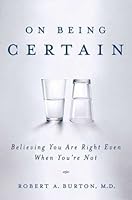
On Being Certain:
Believing You Are Right Even When You're Not by Robert Burton — "What do we do when we recognize that a false certainty feels the same as certainty about the sky being blue?
...In his brilliant new book, Burton systematically and convincingly shows that certainty is a mental state, a feeling like anger or pride that can help guide us, but that doesn't dependably reflect objective truth… In the polarizing atmosphere of the 2008 election, On Being Certain ought to be required reading for every candidate -- and for every citizen." — ForbesLife (Amazon)Labels: Certainty, Objectivity, Robert Burton
Not My Friend
McCain's Tic Is Back: "McCain's 'my friends' tic kicked in with a vengeance and he said it not three or four times but a total of 22 times. Several of those times he said 'my friend,' referring to a questioner in the audience. Moderator Tom Brokaw said 'my friend' once, when he announced next week's moderator, CBS's Bob Schieffer. (Obama said 'my friends' - not once.)" (Washington Post op-ed)
Labels: John McCain


"That One..."
...as McCain Calls Obama In Debate: '"During a discussion about energy, McCain punctuates a contrast with Obama by referring to him as "that one," while once again not looking in his opponent's direction (merely jabbing a finger across his chest). That's not going to win McCain any Miss Congeniality points. Nor will it reassure any voters who believe McCain is improperly trying to capitalize on Obama's "otherness."
This goes beyond refusing to look at Obama in the first debate. With this slightly dehumanizing phrase, McCain may have just played into the emerging narrative of Obama-hate that has been sprouting at McCain-Palin rallies.
Darren Davis, a professor at Notre Dame who specializes in the role of race in politics, sent a comment to the Huffington Post about McCain's "that one" remark. "It speaks volumes about how McCain feels personally about Obama. Whomever said the town hall format helps McCain is dead wrong," Davis wrote.'
Obama Hatred At McCain-Palin Rallies: "Terrorist!" "Kill Him!"
Arianna Huffington: McCain's Desperate Claim: Obama is Dangerous. Vote for Me If You Want to Live!
Jeffrey Feldman: Is Palin Trying To Incite Violence Against Obama?
...(All from Huffington Post)
I have never had more fear that the level of rancor in the population being tapped into against a presidential candidate will get him assassinated.Labels: Arianna Huffington, Huffington Post, John McCain

Tuesday, October 7, 2008
GPS Spoofing
Bruce Schneier takes note of successful experiment sending faked GPS signal with off-the-shelf equipment that can be carried in the back of a car. (Schneier on Security) The implications for national security are evident.
Labels: National security, Schneier

Terrorism Fear Could Create Psychosomatic Epidemic, Feds Warn
"Americans' fear of a terrorism could create a mass outbreak of a psychosomatic illness -- even in the absence of any real attack -- -- creating a fake epidemic that could overwhelm hospitals attempting to treat real victims.
...feds warned hospitals in a nonpublic 2006 communique recently published by the government sunshine site Wikileaks.
...In fact, the feds suggest (.pdf) that there's already been a totally terrorism-fear-created illness in California where no one was actually sick from an attack.
In that case, a man walked into a California bank in October 2003, sprayed an aerosol can into the air and then left. Employees and customers became ill, though investigators found there were no biological or chemical agents in the air. (Note proof of this incident is attributed to a November 2003 FBI report that is also considered too sensitive for the public's eyes.)" (Wired)Labels: Psychosomatic medicine, Terrorism

Monday, October 6, 2008
Receptor Could Halt Blinding Diseases, Stop Tumor Growth, Preserve Neurons After Trauma
"An international team of researchers has discovered what promises to be the on-off switch behind several major diseases.
In the advance online edition of Nature Medicine, scientists from Sainte-Justine Hospital Research Center, the Université de Montréal and the Institut national de la santé et de la recherche médicale (INSERM) in France report how the GPR91 receptor contributes to activate unchecked vascular growth that causes vision loss in common blinding diseases. These findings could also have wide-ranging and positive implications for brain tissue regeneration." (Science Daily)

What Happens When We Ask Autistic Persons What Is Wrong With Them?
"The most striking observations were that all of them pointed out that unusual perceptions and information processing, as well as impairments in emotional regulation, were the core symptoms of autism, whereas the current classifications do not mention them.
The results of this study suggest that what has been selected as major signs by psychiatric nosography is regarded as manifestations induced by perceptive peculiarities and strong emotional reactions by the autistic persons who expressed themselves." (Science Daily)Labels: Mental health

Study: Facebook profiles can be used to detect narcissism
'"We found that people who are narcissistic use Facebook in a self-promoting way that can be identified by others," said lead author Laura Buffardi, a doctoral student in psychology who co-authored the study with associate professor W. Keith Campbell.' (EurekAlert) [And exactly why is this news to anyone? — FmH]Labels: Facebook, Narcissism, Social network

Sunday, October 5, 2008
Lacking Control Increases Illusory Pattern Perception
Book cover via Amazon
Jennifer A. Whitson and Adam D. Galinsky, Abstract: ""We present six experiments that tested whether lacking control increases illusory pattern perception, which we define as the identification of a coherent and meaningful interrelationsh.ip among a set of random or unrelated stimuli. Participants who lacked control were more likely to perceive a variety of illusory patterns, including seeing images in noise, forming illusory correlations in stock market information, perceiving conspiracies, and developing superstitions. Additionally, we demonstrated that increased pattern perception has a motivational basis by measuring the need for structure directly and showing that the causal link between lack of control and illusory pattern perception is reduced by affirming the self. Although these many disparate forms of pattern perception are typically discussed as separate phenomena, the current results suggest that there is a common motive underlying them. (Science, 3 October 2008, Vol. 322. no. 5898, pp. 115 - 117)
Years ago, there was a psychiatric paper I can no longer dig up proposing that belief in ESP was correlated with a history of sexual abuse and other trauma, the link being the experience of the lack of control in abuse. It is more comforting to believe that the skill to foresee, and potentially avoid, disastrous events exists (even if one failed dismally at foreseeing events in the abuse situation; one can believe in the possibility one may not fail the next time...) than to believe that no foresight is possible and that disastrous things defy our abilities to control them.
And on a cultural level, I recall being fascinated by attempts to explain ritual and religion as efforts to exert an illusory control over contingent events. (If we perform our rituals perfectly, the gods won't send that famine. When it comes, it is because we were imperfect in our observance.)
So some distorted, "magical thinking" can come from experience, but it can also come from neurochemical imbalances or abnormalities of neural network formation, as in schizophrenia and other psychoses, especially of the paranoid type, in which too much credence is given to coincidence and patterns are found where there are none. And this amped-up ability to see patterns may not, of course, always work against one. A gifted few seem to have an enhanced ability to make order out of chaos, as per an article from New Scientist to which I blinked in March of 2002.
I have also written further about this on FmH in a discussion of pareidolia and apophenia which touched, among other things, upon William Gibson's preoccupations in the aptly-titled Pattern Recognition (2003).
Labels: Magical thinking, New Scientist, Pattern recognition, William Gibson
![[top of page]](upw.png "go to top of page")
![[Image 'iconfmh.png' cannot be displayed]](iconfmh.png "FmH icon")


![[Powered by Blogger]](http://theworld.com/~emg/uploaded_images/bloggerButton2.png "Powered by Blogger")
![[Blogrolling]](http://theworld.com/~emg/uploaded_images/blogrolling.png "Blogrolling")

![[Made for Mozilla]](http://theworld.com/~emg/uploaded_images/mfmoz.png "Made for Mozilla")


![[FmH-branded items]](http://theworld.com/~emg/uploaded_images/fmhcap.jpg "FmH-branded items")